
When a serious workplace incident leads to criminal proceedings, questions can arise not only about what happened, but what those responsible for safety could reasonably have seen at the time.
In this case, a forensic video expert who works with Forensic Access was instructed following a fatal incident at an aluminium reprocessing facility. By combining CCTV analysis with on-site reconstruction, drone footage and head-mounted cameras, the expert was able to examine lines of sight across a complex industrial environment and demonstrate areas in which an individual could not be seen.
Introduction to the Case
The incident occurred at a facility where aluminium waste, including drinks cans and other recyclable material, was received in large quantities for processing.
Material arriving at the site was deposited into a large industrial hopper before being transferred through the processing system by moving machinery and conveyor equipment. The area beneath the hopper was restricted because of the danger presented by the machinery.
An employee had previously been warned about entering this restricted area. On the day of the incident, however, he entered the area beneath the hopper while the equipment was operating and suffered fatal injuries after coming into contact with the moving mechanism.
The circumstances led to a corporate manslaughter investigation and scrutiny of the safety arrangements in place at the facility. The fact that the employee had entered an area he was not permitted to access was an important consideration. However, the investigation also considered the measures in place to prevent access and whether his presence could reasonably have been detected by those responsible for safety on the site.
The expert was instructed to examine one specific aspect of the case: visibility. Could the employee have been seen through the site’s CCTV system while he was in the restricted area? Also, based on the positions of relevant personnel within the yard, would they have been able to see that he had entered a place of danger?
The Challenge
The key challenge was to establish what could realistically have been seen at the time of the incident.
The CCTV camera provided a view across the wider yard, but the hopper and surrounding structures obscured part of the restricted area beneath and immediately alongside the machinery. The presence of a CCTV camera overlooking the area did not therefore necessarily mean that an operator could see someone who had entered the restricted space.
Establishing the significance of this limitation required more than reviewing the recorded footage. The expert needed to determine the precise boundaries of the camera’s field of view and identify where an individual would move out of sight as they approached and entered the area beneath the hopper.
There was a further question concerning personnel on the ground. CCTV footage provided evidence of where relevant individuals had been positioned or moving within the yard around the time of the incident. However, their proximity to the machinery did not necessarily mean that they had an unobstructed view of the employee.
The expert therefore needed to reconstruct the scene from multiple perspectives, considering both what could be seen through the CCTV system and what could have been visible to individuals at relevant positions within the yard.
This would allow the court to consider the visibility evidence in the context of the actual site layout, rather than making assumptions based simply on the presence of a CCTV camera or personnel nearby.
The Findings
The expert attended the facility to undertake a detailed examination and reconstruction of the scene.
Using the original CCTV footage as a reference, he examined the camera’s field of view and established where the surrounding structures and machinery prevented visibility into the restricted area.
Rather than simply describing these limitations, the reconstruction was designed to demonstrate them physically. The boundary of the area that could not be seen by the CCTV camera was marked on the ground around the hopper. The area was also divided into measured sections, allowing the extent of the non-visible area to be assessed and illustrated.
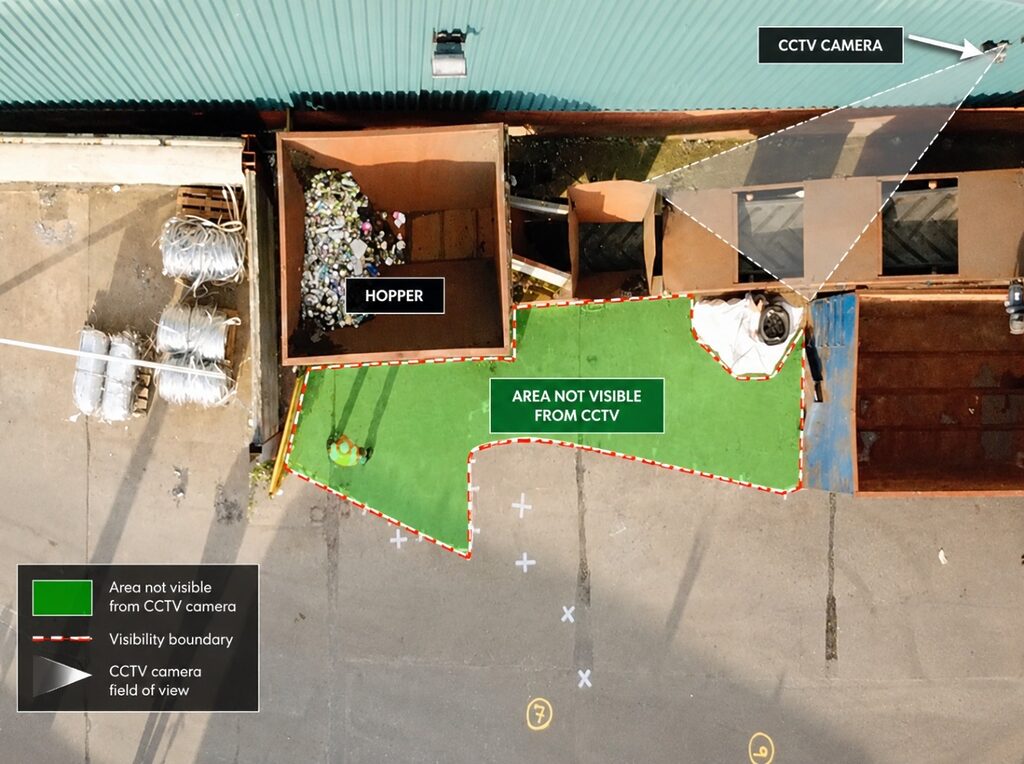
Overhead drone view used to illustrate the mapped area of non-visibility from the CCTV camera.
A drone was then used to record the scene from above. This provided an overhead view of the machinery, surrounding structures and the boundary that had been established during the reconstruction. From this perspective, the relationship between the CCTV camera’s view across the wider yard and the specific areas hidden from view could be demonstrated more clearly.
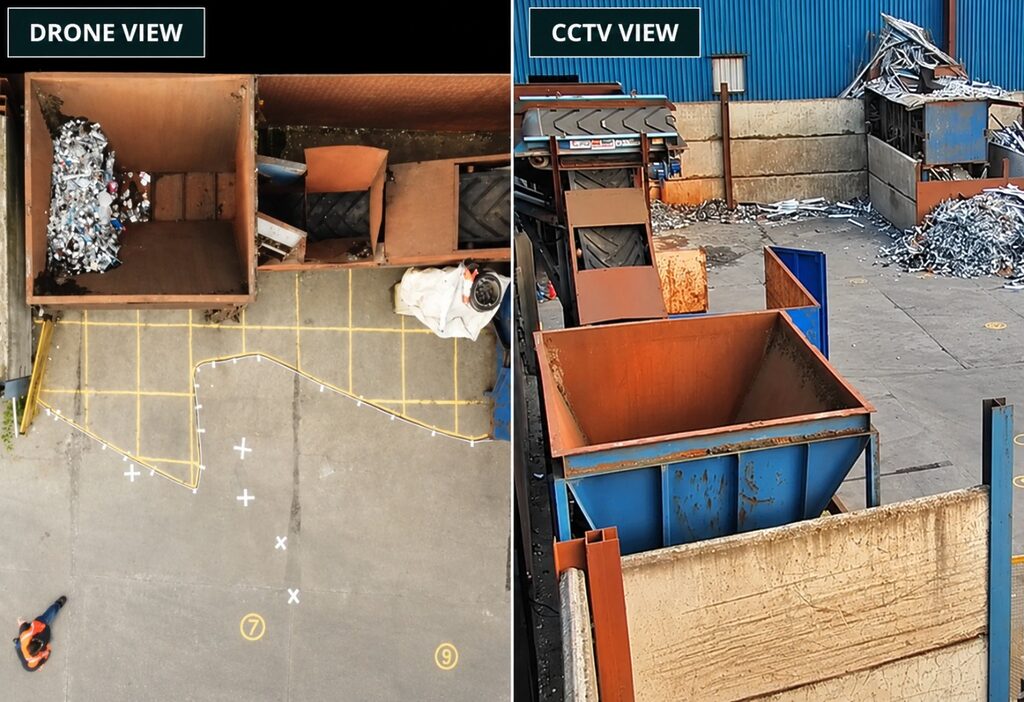
Drone and CCTV views demonstrating the area that fell outside the camera’s line of sight.
The expert also used a person within the reconstruction to test visibility from the CCTV camera. By moving through different positions around the hopper and restricted area, it was possible to demonstrate where the individual remained visible and where they moved from view. This established a defined area close to the machinery in which a person could be present without being visible to someone monitoring the camera.
The second part of the reconstruction considered what personnel physically present within the yard might have been able to see.
Positions and movements identified from the original CCTV were used to establish relevant observation points. A head-mounted camera was then used while those positions were recreated, providing an approximation of the view available to a person standing or moving through each location.
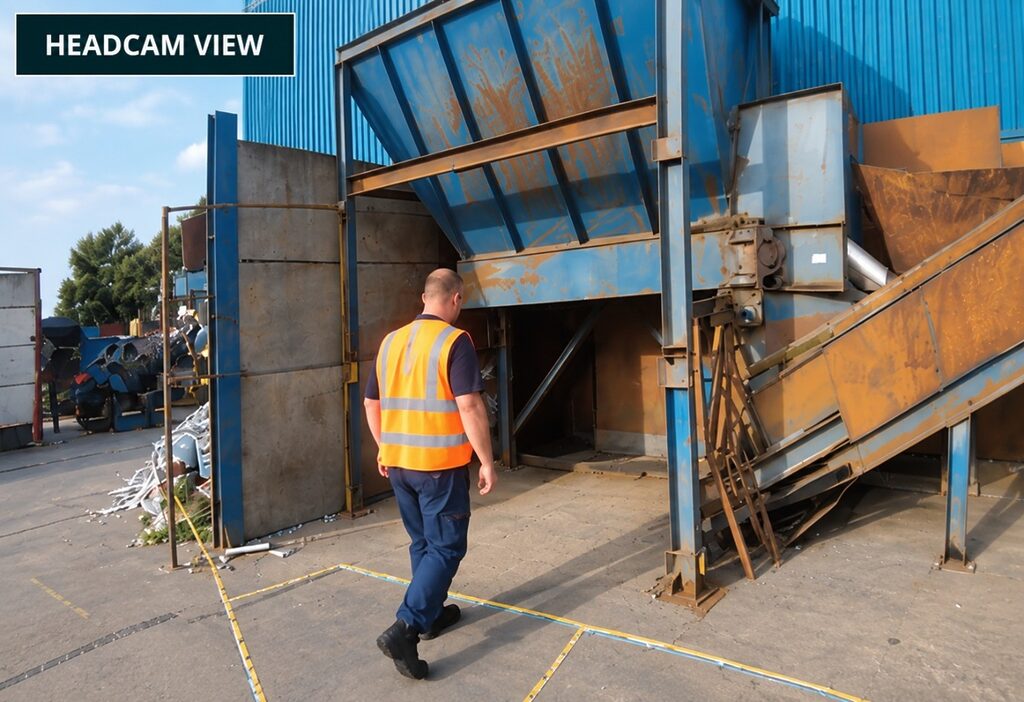
Head-mounted camera footage was used to recreate the view available from relevant positions within the yard.
This was particularly important because an overhead plan or CCTV image cannot fully reproduce a person’s view at ground level. Machinery, walls and other structures can interrupt lines of sight in ways that are much clearer when the scene is examined from eye level.
Finally, the different sources of imagery were synchronised. The original footage, reconstruction CCTV, drone footage and head-mounted camera footage could be viewed alongside one another, enabling the same area to be considered from multiple perspectives.
Together, these techniques provided a visual and measurable assessment of the site’s lines of sight and demonstrated the limitations of what could have been observed from particular locations.
The Outcome
The expert’s findings formed part of a much wider consideration of the circumstances surrounding the fatal incident, including the actions of the employee and the safety measures and procedures in place at the facility. The proceedings concluded without individual custodial sentences, while the company received a substantial financial penalty.
Importantly, the expert’s role was not to determine where responsibility should ultimately lie. His role was to provide objective evidence addressing a specific question: what could, and could not, have been seen?
By reconstructing the scene and testing the available viewpoints, the expert enabled the visibility questions to be considered in the context of the actual physical environment, rather than through assumptions based on the CCTV footage alone.
The case demonstrates how forensic video expertise can extend beyond the examination of recorded footage. Where visibility, perspective or line of sight is disputed, combining video analysis with an on-site reconstruction can help establish the limitations of the available evidence and provide the court with a clearer understanding of the circumstances surrounding an incident.
Partner with Forensic Access
Forensic Access works with experienced forensic video experts who can assist with complex questions involving CCTV, imagery, visibility and scene reconstruction. Where questions arise around what could have been seen from a particular camera or viewpoint, forensic analysis can help establish the capabilities and limitations of the available evidence.
If you require a forensic video analysis expert, CCTV analysis or forensic image enhancement, contact our Casework Team on 01235 774870 or by email at science@forensic-access.co.uk.
Get in touch
Let’s talk
**Please note that we can only take instruction via a Barrister or Solicitor, we do not take instruction directly from private individuals.
We are always interested in talking to experienced forensic scientists with a minimum of 5 years of forensic science work who are interested in working as Consultants to undertake ad-hoc work for us.
Call us
01235 774870
Email us
science@forensic-access.co.uk