
No Results Found.
The page you requested could not be found. Try refining your search, or use the navigation above to locate the post.
**Please note that we can only take instruction via a Barrister or Solicitor, we do not take instruction directly from private individuals.
We are always interested in talking to experienced forensic scientists with a minimum of 5 years of forensic science work who are interested in working as Consultants to undertake ad-hoc work for us.
01235 774870
science@forensic-access.co.uk
When an injury is alleged to have been caused by workplace machinery, CCTV footage may appear to provide important evidence of what happened. However, the quality, angle and distance of a recording can make it difficult to determine precisely whether contact occurred.
In this industrial litigation case, a forensic video expert who works with Forensic Access was instructed to examine an allegation that a worker had suffered a serious foot injury after a mobile access platform travelled over his foot.
By returning to the site and reconstructing the alleged incident, the expert was able to test the account against the physical behaviour of the machine and the original CCTV footage.
The claim arose following an incident at an industrial site involving a mobile elevating work platform, commonly referred to as a cherry picker. The claimant reported that he had been standing close to the machine while speaking with its operator. It was alleged that, as the machine moved away, one of its wheels travelled over his foot, causing a significant injury.
The circumstances of the incident had been captured on CCTV. However, the available footage did not provide a sufficiently detailed view to establish simply by watching the recording whether the wheel had passed over the claimant’s foot.
The expert was therefore instructed to undertake further analysis and determine whether the movement visible within the footage could assist in assessing the account of the incident.
The central question was relatively straightforward: If the machine had travelled over the claimant’s foot, would its movement have been affected in a way that could be identified in the CCTV?
CCTV footage can provide valuable evidence in personal injury and industrial litigation, but it does not always capture the critical detail directly.
In this case, the position and resolution of the camera meant that the precise relationship between the machine’s wheel and the claimant’s foot could not be established reliably from the images alone.
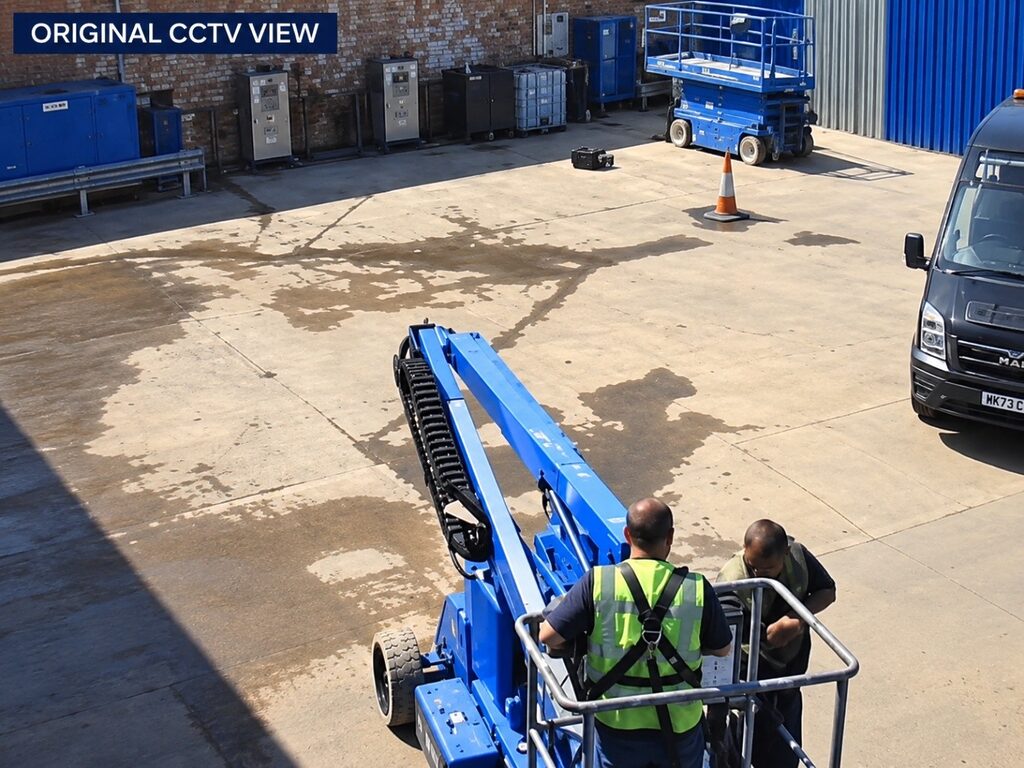
Original CCTV view showing the cherry picker and the wider area in which the alleged incident occurred.
The expert therefore needed to consider whether there was another measurable consequence of the alleged contact.
The expert considered whether travelling over an object beneath one of the cherry picker’s wheels would produce an observable effect on the movement of the machine. The challenge was to recreate comparable conditions safely and establish what movement would be expected if the machine travelled over an object representative of the claimant’s protected foot.
This could then be compared with the behaviour of the machine captured in the original footage.
The expert attended the site to reconstruct the alleged incident using the relevant type of cherry picker. A protective steel toe-capped boot was positioned in the path of the machine, and the wheel was deliberately driven over it, with the test recorded for subsequent analysis.
The reconstruction demonstrated that contact with the boot produced observable movement in the cherry picker as the wheel encountered and passed over the obstruction.
The original CCTV footage was then stabilised and examined alongside the reconstruction. Reference points were used to identify when the machine began to move, the point at which the alleged contact would have occurred and its movement immediately afterwards.
This comparison showed that the movement produced when the cherry picker travelled over the boot during the reconstruction was not evident at the corresponding point in the original CCTV footage.
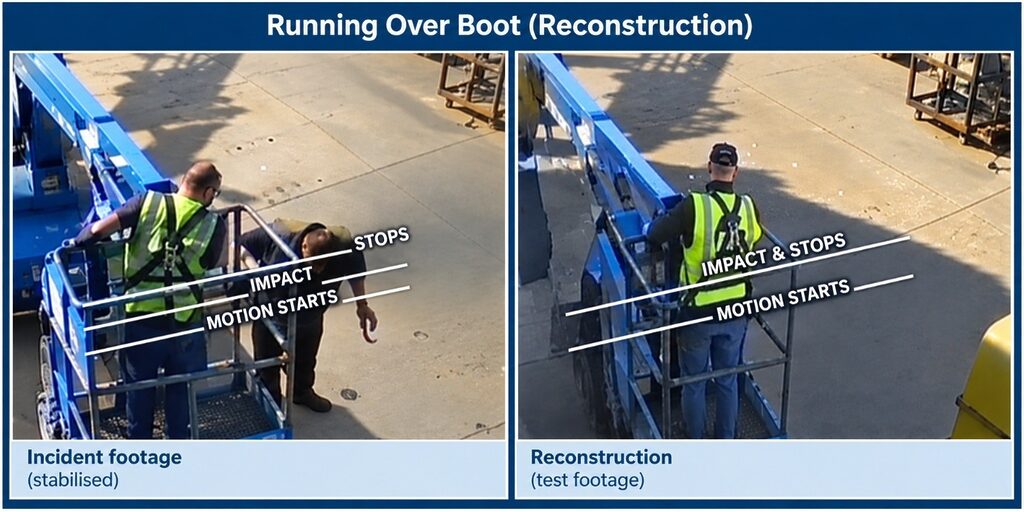
Reference points within the incident and reconstruction footage were used to compare the movement of the machine before, during and after the point of expected contact.
The reconstruction formed part of wider testing undertaken at the site. This included additional sound tests and the use of marked reference lines on the ground to assist with the examination of the circumstances surrounding the alleged incident.
Taken together, the analysis provided a means of testing the reported mechanism of injury against the physical behaviour of the machine, rather than relying solely on whether the precise point of contact could be seen in the CCTV.
The expert’s role was not to determine whether the claim itself was genuine, but to address a specific question objectively: if the cherry picker had travelled over the claimant’s foot as alleged, would the resulting movement be expected to be visible in the footage?
The reconstruction provided a practical means of answering that question and gave those involved in the litigation additional evidence with which to assess the reported circumstances of the injury.
The case demonstrates how forensic video expertise can extend beyond the examination of recorded imagery. Where a critical event is unclear or partially obscured, carefully designed reconstruction can help test an account against observable physical behaviour and provide evidence that may not be apparent from the original footage alone.
Forensic Access works with experienced forensic video experts who can assist with the examination and interpretation of CCTV and other recorded imagery. Where questions arise about movement, timing, perspective or the circumstances captured within footage, practical reconstruction can also be used to test competing explanations against observable evidence.
If you require a forensic video analysis expert, CCTV analysis or forensic image enhancement, contact our Casework Team on 01235 774870 or by email at science@forensic-access.co.uk.
**Please note that we can only take instruction via a Barrister or Solicitor, we do not take instruction directly from private individuals.
We are always interested in talking to experienced forensic scientists with a minimum of 5 years of forensic science work who are interested in working as Consultants to undertake ad-hoc work for us.
01235 774870
science@forensic-access.co.uk