
No Results Found.
The page you requested could not be found. Try refining your search, or use the navigation above to locate the post.
**Please note that we can only take instruction via a Barrister or Solicitor, we do not take instruction directly from private individuals.
We are always interested in talking to experienced forensic scientists with a minimum of 5 years of forensic science work who are interested in working as Consultants to undertake ad-hoc work for us.
01235 774870
science@forensic-access.co.uk
This case study demonstrates how specialist forensic video analysis and scene reconstruction can help establish the facts in complex workplace incidents, insurance claims and civil disputes where CCTV footage alone cannot answer the critical questions. Independent forensic analysis helps ensure that conclusions are based on scientific evidence rather than assumptions.
Forensic audio and video enhancement is a highly specialised discipline that applies scientific techniques to the examination, interpretation and presentation of digital evidence. By combining CCTV analysis with accurate measurements, scene reconstruction and practical testing, experts can determine vehicle speeds, lines of sight, timings and visibility. This objective approach enables investigators, insurers and the courts to better understand how an incident unfolded and whether assumptions drawn from video footage are supported by the available evidence.
An experienced forensic audio and video enhancement expert was instructed to provide independent analysis following a serious workplace incident involving an industrial forklift truck and a pedestrian.
Although the collision had been captured on CCTV, the footage alone could not fully explain what had happened immediately before the incident. Independent expert analysis was required to reconstruct the sequence of events, determine whether the forklift operator could have seen the pedestrian, and establish whether the forklift truck was being operated safely and appropriately at the time of the collision.
The investigation combined detailed forensic video analysis with scene examination and practical testing to provide an objective, evidence-based reconstruction of the incident.
The CCTV footage provided an important record of the incident but left several critical questions unanswered.
The investigation needed to determine:
Answering these questions required considerably more than simply reviewing the CCTV recording. A detailed forensic examination of both the scene and the available video evidence was required to produce reliable, scientifically supported conclusions.
The investigation began with a detailed examination of the CCTV footage to establish the movements of both the forklift truck and the pedestrian throughout the incident. A site visit was then undertaken to obtain accurate measurements of the location and document the original CCTV camera positions. Distance markers were positioned throughout the area, allowing precise calculations of vehicle movement and speed using the timing information contained within the recorded footage.
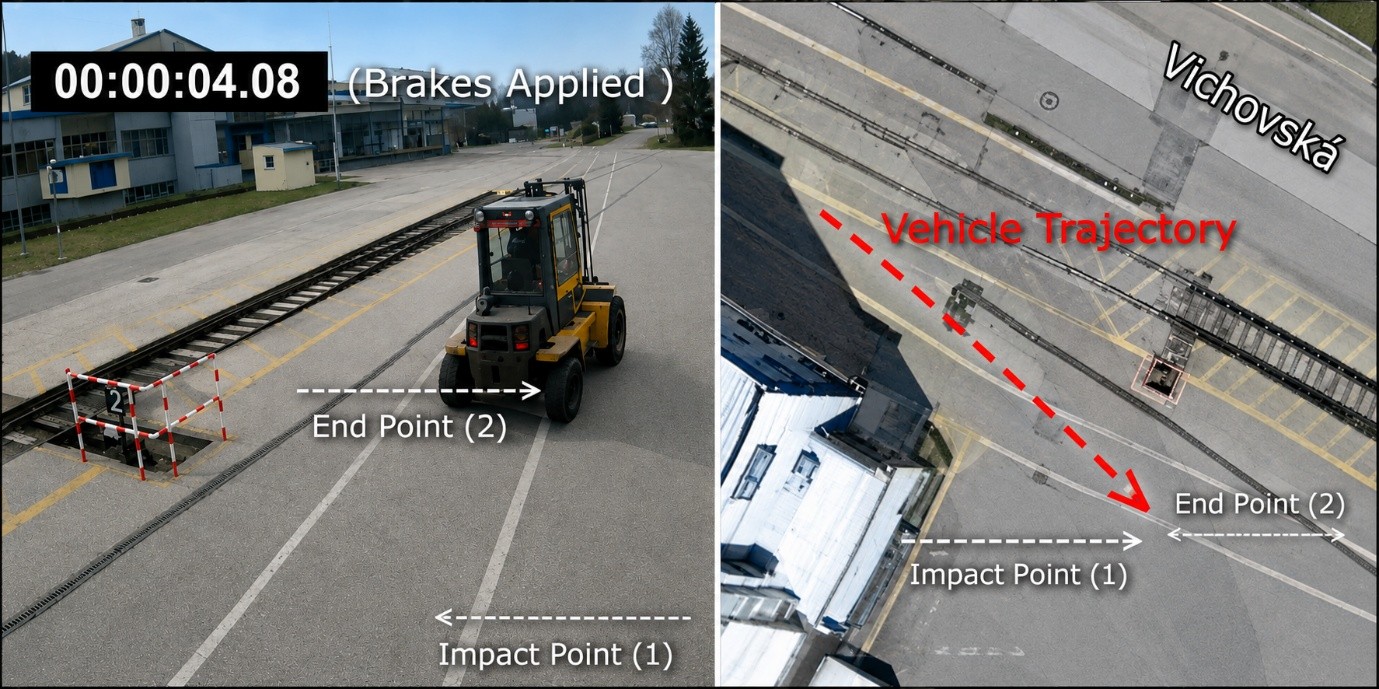
CCTV footage and scene measurements were used to reconstruct the vehicle’s movement, braking point and trajectory.
Practical testing was carried out using the same type of forklift truck together with additional recording equipment, including head-mounted cameras, to recreate the driver’s perspective as the vehicle travelled through the site. These tests allowed direct comparison between what the CCTV cameras recorded and what the driver could realistically observe from inside the cab.
The combination of technical analysis and practical testing enabled the expert to distinguish between what the CCTV appeared to show and what the driver could realistically observe in real time. This distinction proved essential when assessing the driver’s actions and interpreting the circumstances leading up to the collision.
Particular attention was given to the structural design of the forklift. Repeated testing demonstrated that the vehicle’s support pillars created temporary blind spots as the vehicle moved through the scene. By combining the reconstructed driver’s view with the CCTV footage, it was possible to demonstrate occasions where the pedestrian briefly disappeared from the driver’s field of vision despite remaining visible from the fixed CCTV cameras.
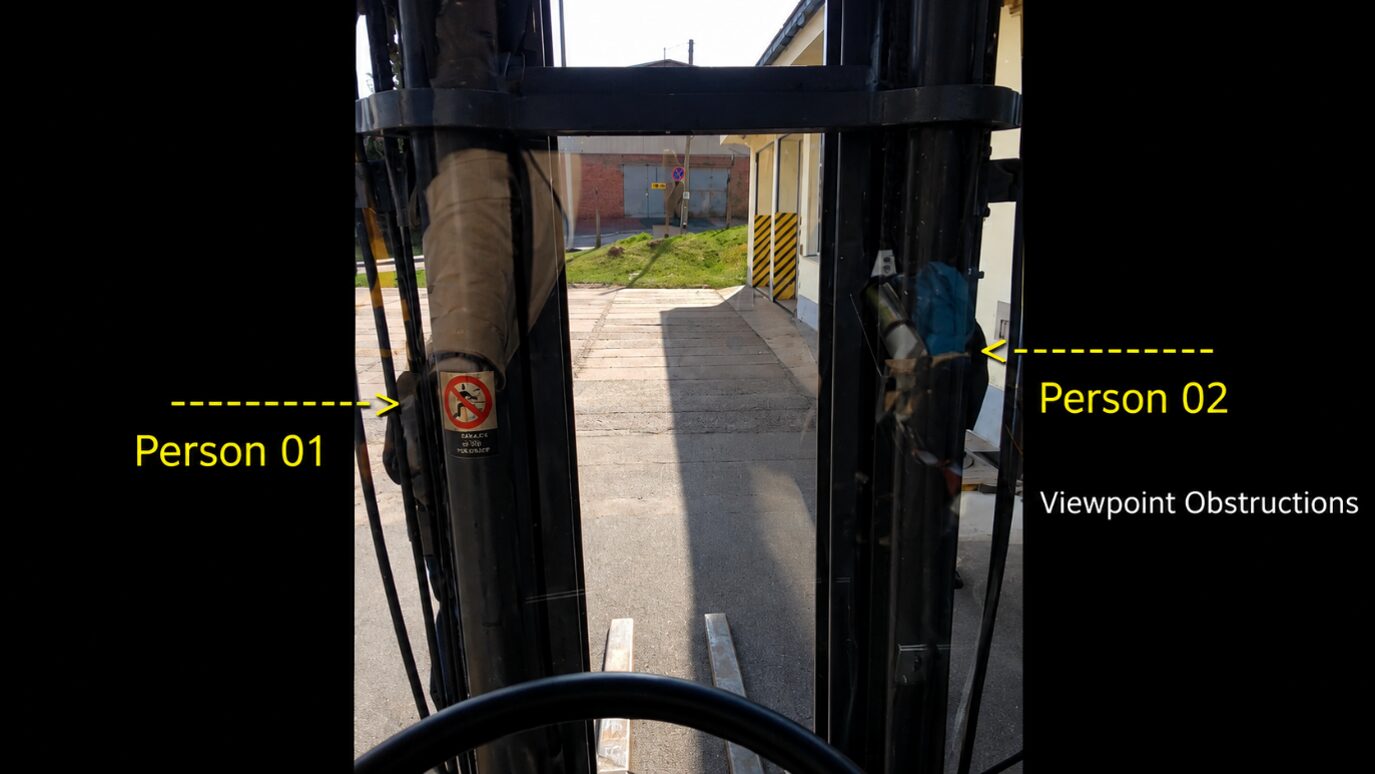
Reconstructed driver viewpoint demonstrating how the forklift’s support pillars created temporary blind spots, obscuring pedestrians from view at key moments.
Vehicle speed was independently calculated using measured distances and the timing information extracted from the CCTV footage. The analysis confirmed that the forklift truck was travelling within the site’s operating speed limits and that excessive speed was not a contributing factor.
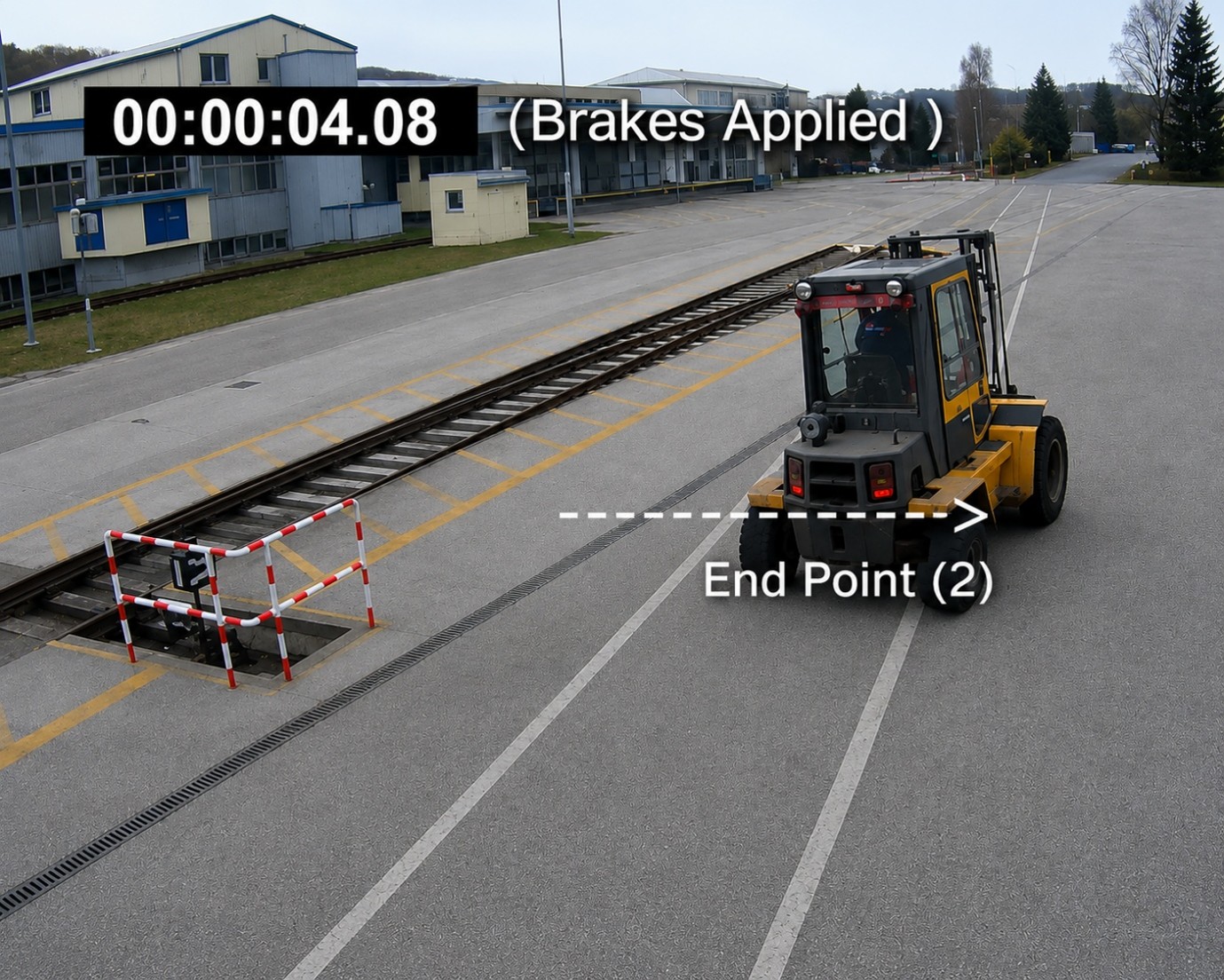
Timing information extracted from CCTV footage was used to identify the breaking point and reconstruct the forklift truck’s movements.
Bringing together CCTV analysis, scene measurements and forensic scene reconstruction enabled the expert to produce clear visual evidence showing the vehicle’s movements, the driver’s available field of view and the sequence of events leading up to the incident. This independent, evidence-based incident reconstruction helped legal representatives and insurers assess liability using objective scientific findings rather than assumptions drawn from CCTV footage alone.
The forensic analysis provided an objective, evidence-based explanation of the incident, allowing the legal team to distinguish between assumptions based solely on CCTV footage and what the driver could realistically have seen from the operating position.
The evidence demonstrated that the forklift truck was being operated within the site’s operating speed limits and highlighted the significance of the temporary blind spots created by the vehicle’s design.
By presenting the findings through clear visual reconstructions, the expert witness helped explain complex technical evidence in an accessible and objective manner.
Beyond supporting the legal proceedings, the investigation also provided valuable insight into workplace health and safety procedures and risk management. Forensic video analysis can assist insurers, employers and legal teams involved in workplace accident investigations and liability disputes. This specialist forensic discipline can help establish the facts, inform liability decisions and identify opportunities to reduce the risk of similar incidents in the future.
At Forensic Access, we coordinate independent forensic experts across a wide range of disciplines, providing insurers, solicitors, businesses, police forces and regulatory bodies with access to specialist scientific expertise when complex incidents require independent investigation. Our forensic audio and video enhancement experts support workplace incidents, liability disputes, insurance claims, criminal investigations and civil litigation through objective analysis of CCTV, body-worn video, mobile phone footage and other digital evidence.
Using advanced enhancement techniques, scene reconstruction and scientific analysis, we help legal professionals understand complex visual evidence and present clear, objective findings that support informed decision-making.
If you require a forensic video analysis expert, CCTV analysis or forensic image enhancement, contact our Casework Team on 01235 774870 or by email at science@forensic-access.co.uk
**Please note that we can only take instruction via a Barrister or Solicitor, we do not take instruction directly from private individuals.
We are always interested in talking to experienced forensic scientists with a minimum of 5 years of forensic science work who are interested in working as Consultants to undertake ad-hoc work for us.
01235 774870
science@forensic-access.co.uk