
This case study is drawn from a recent webinar delivered by Chris Goddard, Forensic Collision Consultant at Forensic Access, exploring how forensic collision investigation can uncover vital evidence in complex road traffic cases.
Forensic collision investigation is the scientific process of reconstructing road traffic incidents to establish how and why they occurred. By applying principles of physics, mathematics, engineering, and human factors, collision investigators provide the courts with clear, impartial analysis that helps inform decision-making.
In cases involving commercial vehicles, such as Heavy Goods Vehicles (HGVs), the stakes can be particularly high. These vehicles present unique challenges, including limited visibility, large blind spots, and complex vehicle dynamics. Witness accounts alone are often unreliable, especially when incidents unfold quickly on busy roads. Forensic collision investigators play a vital role in these situations by providing accurate, objective insights that help courts understand the true sequence of events.
Introduction to the Case:
This case involved a motorway collision between an HGV and a car, leading to the HGV being prosecuted for driving without due care and attention. The expert investigation helped the court assess the circumstances fairly and ultimately played a key role in the outcome.
Background:
The incident took place on a motorway when a car, having joined from a slip road, merged into the main carriageway alongside an HGV. The slip road formed a new lane, and under normal circumstances, the car would have remained safely in this lane as both vehicles continued travelling at motorway speeds.
However, impact marks later revealed that both the car and the HGV had deviated slightly from their original positions. The car made contact with the side of the HGV, causing the car to spin across the motorway into the path of a second HGV, resulting in a significant secondary collision.
The initial contact between the car and the first HGV was so minor that the prosecution and defence agreed the HGV driver would not have been aware of it. The prosecution nonetheless argued that the HGV driver had failed to exercise due care and attention.
To address this, forensic analysis was required to establish exactly what had happened, whether the HGV driver could have reasonably been expected to notice the impact, and whether the actions of the car contributed to the incident.
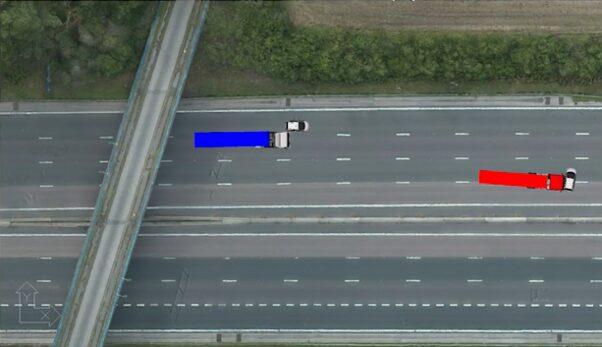
Visual representation of the motorway road layout and vehicle positions at the time of the HGV 1 and HGV 2 collision with the car.
The Challenge:
The central question to this case was whether the HGV driver had failed in their duty of care by not noticing the presence of the car and causing the initial contact. The risks were significant, as the case could have led to a criminal conviction for careless driving.
Expert analysis was essential because the investigation needed to:
- Determine the precise movements and positioning of both vehicles leading up to the collision.
- Establish whether the HGV driver could have seen the car prior to the collision using the vehicle’s mirrors.
- Interpret tachograph data to understand vehicle speed and positioning.
- Conduct a mirror survey to accurately map the driver’s field of vision and identify any blind spots.
- Present the findings in a clear and objective way that would assist the court in understanding the technical evidence.
The Findings:
To answer the key questions raised in this case, a detailed forensic investigation was conducted. By combining physical evidence, digital modelling, vehicle data, and scientific research, the court were provided with a clear and objective reconstruction of the incident.
The investigation involved several essential steps:
- Analysis of Vehicle Positions and Movements:
Through examination of impact marks on both the car and the HGV, the investigation established that both vehicles had moved slightly from their original paths before the collision occurred. This was a crucial finding as it demonstrated that neither vehicle was entirely maintaining its lane, which helped explain how the initial contact occurred. Also, this data suggested that the car was not maintaining a steady position and was also partially responsible for the circumstances that led to contact. - Tachograph Data Review:
The digital tachograph installed in the HGV was examined to assess speed and driving patterns and behaviour in the lead-up to the incident. Although the tachograph is not specifically designed as a collision investigation tool, it can provide valuable information that greatly assists the investigative process.
Tachographs are designed to monitor driving hours and rest periods; they also record speed and distance data at regular intervals. The tachograph in this case confirmed that the HGV was travelling at a steady cruising speed, within legal limits, and not engaging in any erratic behaviour or unsafe manoeuvres.
This data helped to reinforce that the driver was operating the vehicle appropriately.
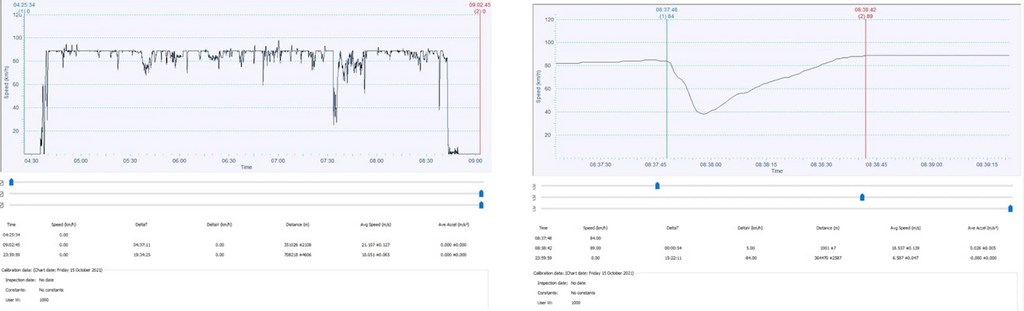
Tachograph data from the HGV, assessing speed and driver behaviour.
- Mirror Survey and Blind Spot Mapping:
A comprehensive mirror survey was undertaken to establish what the HGV driver could and could not see at the time of the collision.
Using a combination of photographs and measurements, the fields of view provided by each mirror, including Class III, IV, V, and VI mirrors. Each mirror provided different fields of view, but the analysis identified the presence of unavoidable blind spots, particularly on the near side of the vehicle.
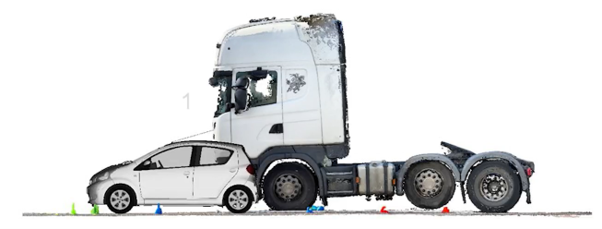
3D digital model to show the position of the vehicles at the time of the collision
- 3D Digital Modelling:
A detailed computer-generated model of the incident was created to show the positioning of the car alongside the HGV at the point of impact.
This model was overlaid with the results of the mirror survey, visually demonstrating that most of the car was outside the driver’s field of vision at the critical moment. This visual reconstruction clearly demonstrated that, at the moment of contact, most of the car was located within a blind spot and was not visible to the driver.
The blind spot effectively concealed the car from view, making it reasonable to conclude that the driver would not have been aware of its presence.
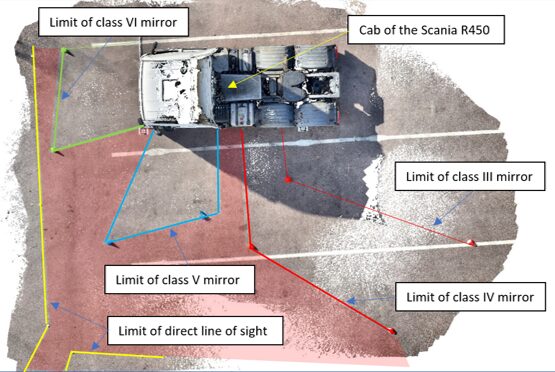
Computer-generated model to show car positioning to the HGV, as well as the mirror survey to establish blind spots.
- Presentation of Evidence to the Court:
The findings were presented in a clear and accessible way, using both the 3D model and supporting images to help the court understand the technical evidence. The visual presentation helped explain the practical realities of HGV driving, including the challenges posed by blind spots and limited visibility.
The combined results of this investigation led to several important conclusions:
- The initial contact between the car and the HGV was minimal, causing very slight damage that the driver could not have been expected to notice.
- The HGV was travelling at a consistent and lawful speed with no evidence of dangerous or careless driving behaviour.
- The car was positioned within a blind spot at the time of the collision, making it invisible to the HGV driver despite the presence of multiple mirrors.
- Both vehicles had deviated slightly from their expected positions, suggesting that the incident was not solely attributable to the actions of the HGV driver.
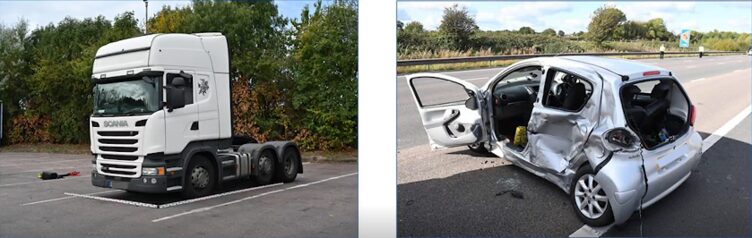
Comparison of damage between HGV 1 and the car involved in the incident.
These findings were accepted by the court, which found that the case against the HGV driver was unproven. Therefore, the HGV driver was acquitted.
This case highlights the importance of thorough forensic investigation in complex road traffic incidents. By applying a scientific approach to the available evidence, critical insights were revealed and clear answers provided to the court to ensure that the driver was not charged for circumstances beyond their control.
Partner with Forensic Access
At Forensic Access, we provide expert analysis and support in collision investigation, as well as a wide range of forensic disciplines. Our experienced specialists deliver clear, impartial evidence that assists courts and legal teams in understanding complex incidents.
If you require assistance with collision reconstruction, expert witness testimony, or related forensic services, our team is here to help.
Contact our Casework Management Team via email at science@forensic-access.co.uk or by phone on 01235 774870.
Get in touch
Let’s talk
**Please note that we can only take instruction via a Barrister or Solicitor, we do not take instruction directly from private individuals.
We are always interested in talking to experienced forensic scientists with a minimum of 5 years of forensic science work who are interested in working as Consultants to undertake ad-hoc work for us.
Call us
01235 774870
Email us
science@forensic-access.co.uk