
Textiles are part of almost every aspect of daily life, and as such they often become silent witnesses to violent events. Yet textile damage analysis is sometimes underestimated in comparison to higher profile evidence types such as DNA.
From a seam torn during a struggle to a stab cut in a hoodie or heat damage generated during an act of arson, damaged fabrics can hold crucial information about the actions which have taken place, the implements used and the sequence in which events unfolded. Fabrics record events in a way that can be highly revealing when examined with care, experience and an understanding of how materials behave.
The aim of this article is to give an overview of how textile damage examinations are conducted and why they remain a powerful tool in reconstructing events across a wide range of criminal cases.
What does a textile damage examination involve?
The applications of textile damage analysis are far broader than simply inspecting clothing for cuts, tears or holes. Although clothing is the most common exhibit to be submitted for this type of examination, any textile can be examined. This includes bedding, curtains, upholstery, vehicle interiors or any object where woven, knitted or felted materials form all or part of its structure.
In any textile damage examination, the first question which needs to be addressed is usually straightforward: ‘Is there damage present and, if so, is it relevant to the case?’ Once relevant damage has been identified, the work falls into three main areas:
1. Determining the mechanism and recency of damage
A central aim is to understand what caused the damage. For example, was the fabric cut by a knife, torn by force, abraded by friction or punctured by an implement? Many cases depend on whether the damage is compatible with the account given by an individual. For example, is a garment torn in a way that fits with a struggle, or does it display features strongly suggestive of cutting with a sharp blade?
Another important concept is ‘recency’. In the context of examining textile damage the term ‘recent’ does not refer to a precise time window but indicates that the garment has not been washed or worn extensively since the damage occurred. This is because washing, prolonged wear or environmental exposure can soften, distort or obscure the fine features generated at the time the damage was caused. Establishing recency helps determine whether the damage is likely to be associated with the incident under investigation.
2. Comparing damage with potential causative implements
In many cases, investigators want to know whether a particular weapon or object could have caused the observed textile damage. This often involves knives but may also include machetes, scissors, screwdrivers, axes, hammers or improvised items. Even household objects can generate distinct textile signatures.
Scientists may also be asked whether the damage is more likely to be generated by a stabbing action rather than a slashing action, or whether multiple cuts represent multiple actions. The complexity increases when folds and layering of clothing, and movement of the wearer are considered. Clothing rarely sits flat during an assault. Items can bunch, twist or lift as a person moves in response to threat or pain, and this can influence the appearance of the resulting damage.
3. Physical Fit Examinations
Sometimes the question is whether two pieces of fabric once formed part of the same garment or item. This is known as a physical fit or jigsaw fit examination. Although occasionally the pieces can be aligned perfectly, it is often more complex. Missing sections, distortion and incomplete edges require additional comparisons of fabric type, weave, colour, stitching patterns and overall wear.
A physical fit can provide exceptionally strong evidence that two items once belonged together and may support or refute an account offered by a suspect or victim.
Typical Case Types
Textile damage analysis appears across a wide range of investigations:
Violent Assaults and Homicides
Damage to clothing can help answer questions about the number and direction of stabbing or slashing actions, whether a weapon may have been used, or whether the pattern of damage is consistent with defensive movements such as raising the arms.
Sexual Offences
Where consent is disputed, damage to underwear or clothing may be one of the few features capable of supporting or challenging accounts. Recently torn seams or ripped fabric can be highly significant.
Kidnappings
Textile comparison can assist in the examination of ligatures, bindings or gags, including whether torn fabric used to restrain someone matches materials recovered elsewhere.
Burglaries
Fragments of fabric can be found at points of entry, on barbed wire, broken glass or protruding nails, allowing comparisons to any suspect’s clothing.
Road Traffic Collisions
Abrasions to clothing may help determine contact with the road surface, whether a person was dragged or was under a moving vehicle, and in what orientation.
Arson and Thermal Damage
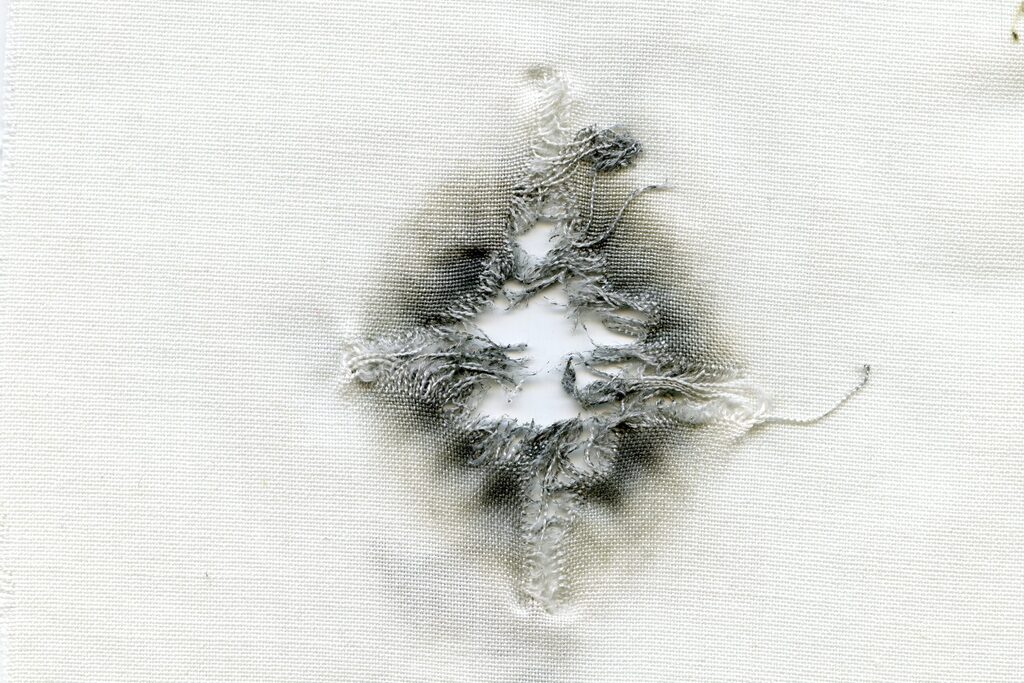
Fabrics show characteristic patterns when exposed to heat or flame. Even microscopic features, known as flash damage, can be important in cases involving accelerants or incendiary devices, allowing an evaluation of a wearers proximity to the events being investigated.
Ballistic Damage
Entry and exit holes, often coupled with associated soot or residues, can provide vital information. Forensic firearms specialists can recreate ballistic damage under controlled conditions to support interpretation.
Corrosive Substance Attacks
Different fibre types respond differently to acids, alkalis and oxidising agents which can cause distinctive chemical degradation to fibres.
Understanding Common Types of Damage
General Wear and Tear
Recognising normal wear helps distinguish evidential damage from everyday deterioration. Areas subject to heavy wear such as elbows, hems or inside pockets may naturally unravel, fray or thin. Modern fashion trends can complicate matters because some garments are manufactured with intentional distressing.
Cuts
Cuts are among the most common and important forms of textile damage. Their features depend on the sharpness of the implement, the type of fabric and the dynamics of the cutting action. A sharp blade typically produces cleanly severed fibres aligned in a single plane. In contrast, blunt knives may distort or tear fibres before slicing them. Similarly, a smooth-edged blade will tend to produce much neater damage features than a serrated blade. It is also necessary to consider whether a single stabbing action through folded fabric could generate multiple stab holes. Scissor damage may display distinctive features allowing it to be confidently distinguished from damage caused by a single bladed instrument.
Tears
Tears tend to follow the weave or knit of the fabric, with the yarns and fibres parting along the line of least resistance. Torn areas usually display a chaotic arrangement of fibre ends that vary in length sometimes with associated distortion in the surrounding fabric. Most textiles are surprisingly difficult to tear with bare hands and seam separation is often more common than true tearing of the fabric.
Punctures
Puncture damage is generated when objects force yarns and fibres apart penetrating through a layer of fabric. The surrounding fabric often shows stretching and distortion. The shape of the resulting hole can sometimes help to identify the type of implement.
Abrasions
Abrasive damage ranges from superficial disturbance of the fabric surface to deep, penetrating frictional wear. Directionality can sometimes be established from the pattern of displaced fibres.
Thermal Damage
Synthetic fibres melt when exposed to high heat, while natural fibres char. Mixed-fibre garments display different responses depending on composition.
How Forensic Scientists Examine Textile Damage
The process begins with a detailed visual inspection under good lighting. A low power microscope is then used to examine the characteristics of the edges and fibre ends of any damaged area. Photographs and measurements are taken, and critical findings are reviewed independently by a second scientist.
Reconstruction Experiments
Where appropriate, reconstruction tests are carried out. Scientists may attempt to reproduce damage on a garment itself in an area away from evidential features or on similar fabrics. When permitted, the questioned implement such as a knife may be used. If not, an implement of comparable shape and sharpness will be obtained.
Variables such as blade angle, penetration depth, fabric tension and velocity are controlled and adjusted to see whether similar damage can be produced. This helps determine how the original damage may have occurred.
Comparison with the findings of a pathologist can also be crucial. Damage to clothing does not always match the number or appearance of wounds on the body, particularly when loose clothing moves during an assault.
Limitations
Textile damage examination has inherent limitations, and these must be acknowledged. In many cases, examiners can exclude an implement with confidence, but inclusion is usually more cautious. A scientist may conclude that a particular knife, or any other implement with similar characteristics, could have produced the damage.
Assessing the degree of force is rarely possible except in very general terms. Too many variables, including blade sharpness, fabric type and movement during the action, influence the appearance of the damage.
Case Study 1
Stab Damage and a Blunt Knife
A complainant suffered a single fatal stab wound to the lower abdomen. Witnesses described the defendant punching the complainant. A knife recovered from the defendant’s home address was alleged to be the murder weapon. No blood or DNA linked either party to the knife.
Examination of the complainant’s hooded top revealed a typical stab hole on the lower front right side, corresponding with the fatal wound. The knife proposed by the prosecution had notably blunt cutting edges and a rounded tip.
Reconstruction tests were carried out using this knife on an undamaged area of the same garment. Despite varying force, angle, fabric tension and stabbing speed, the test damage consistently showed significant distortion and tearing rather than the neat, cleanly severed fibres seen in the evidential stab hole.
These differences were clear and reproducible. Evaluating both prosecution and defence propositions, the scientific findings provided strong support for the view that the proposed knife was not the implement that caused the fatal stab damage.
Case Study 2
A Fabricated Defence
In another case involving a shooting and alleged assault, the defendant claimed the complainant had grabbed and ripped his hooded top during a struggle. A piece of matching fabric had been recovered separately. Although the two pieces formed a clear physical fit, closer examination revealed fine details inconsistent with simple tearing.
Microscopy identified some characteristics typical of being generated by an implement with a sharp edge, these included snippets of unattached yarn and parted yarns in a neat alignment. These features are typical of the use of scissors and support the view that at least some of the damage was initiated, and in some cases fully generated by a cutting action with scissors, and then possibly propagated by tearing. The features appeared recent and contradicted the defendant’s account that the damage occurred during a physical struggle. The evidence supported the view that the damage had been deliberately created in an attempt to support a false claim of self-defence.
Conclusion
Textile damage analysis remains a vital but often overlooked aspect of forensic science. Fabrics record events in ways that can clarify or challenge accounts, identify the use of specific implements and provide insight into the dynamics of violent encounters. Although it cannot always deliver definitive answers, this discipline offers a powerful means of understanding what actions have occurred when clothing and textiles are damaged during criminal events.
Fashion and the nature of fabrics used in manufacturing may evolve and the implements used in the commission of crimes, including offences against people can change, but the fundamental principles of textile damage analysis remain constant. In a justice system that relies on robust, unbiased scientific evaluation, the careful examination of damaged textiles continues to play a crucial role.
If you require an expert report involving textile damage examination or any other forensic discipline, please contact our Casework Management Team by email: science@forensic-access.co.uk or call: 01235 774870.
Get in touch
Let’s talk
**Please note that we can only take instruction via a Barrister or Solicitor, we do not take instruction directly from private individuals.
We are always interested in talking to experienced forensic scientists with a minimum of 5 years of forensic science work who are interested in working as Consultants to undertake ad-hoc work for us.
Call us
01235 774870
Email us
science@forensic-access.co.uk